
Learning to See the City
 AuthorPostedby
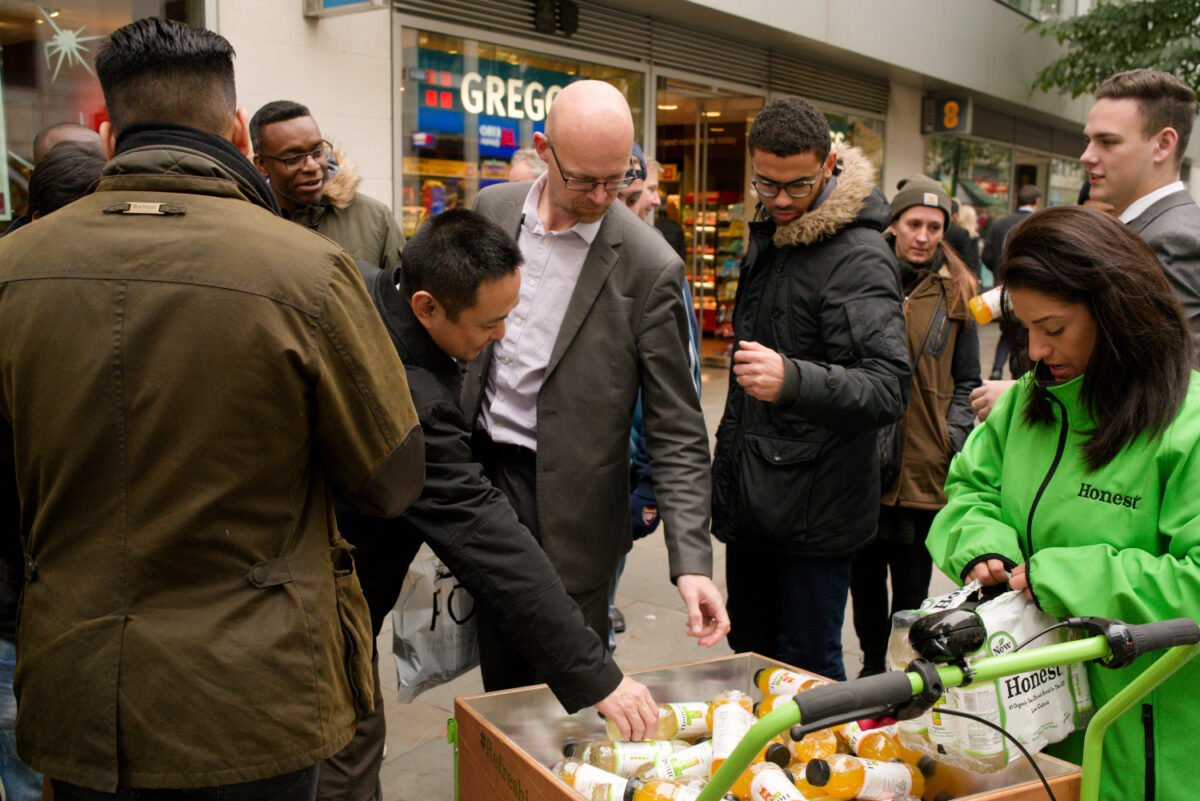
A woman hands out free drinks from a branded bicycle in the City of London while office workers reach past her without really looking at her.
I keep returning to the photograph because I still cannot decide if it belongs in the book.
One photograph, I keep returning to shows office workers taking free drinks from a promotional bike in the City. A woman stands there adding more to the cart with the word “Honest” printed across her jacket. The people taking the drinks barely acknowledge her. They move through the interaction with the same efficiency as if tapping a payment card or scanning a ticket barrier. The exchange lasts seconds.
I am currently editing around 32,000 street photographs made in the City of London between 2015 and 2019 and I am still not sure if there is a photobook in there I do really hope that is though. That uncertainty has become part of the editing process now. Some images that felt important when I first made them feel too obvious to me now. Other photographs that barely registered during the first edit, have started to stay in my mind much longer. I am beginning to trust these quieter images more, although I still do not fully understand why some photographs continue to hold attention and others collapse almost immediately.
Part of the problem, is that the image almost explains itself too quickly. Good documentary photographs usually need more room than that. If an image closes down interpretation immediately it can become illustrative rather than suggestive. Photography cannot explain capitalism. It can only show what capitalism looks like when people live inside it every day.
That has become increasingly important while editing this work. I photograph on the street, but over time I became less interested in isolated moments and more interested in social relationships. Gestures. Repeated behaviours. The emotional atmosphere created by financial spaces. The way people move through architecture designed around money, labour, speed, efficiency, security and consumption. I concentrated specifically on the City of London because it is one of the major global financial centres and because so much of its power remains inaccessible. I cannot walk into private trading floors or corporate meetings with a camera. I can only photograph what becomes visible on the surface.
That surface matters.
The work comes out of street photography, but I am more interested in what happens when documentary sequences begin describing social structures over time. A single photograph rarely carries enough weight on its own. Meaning begins accumulating through repetition, rhythm, spacing, gestures, expressions, relationships between pictures placed pages apart from one another. One image of exhaustion means very little. Twenty photographs containing variations of fatigue, advertising, waiting, isolation, performance, consumption and transactional behaviour begin creating another kind of description altogether.
I think this is partly why editing has become more difficult than photographing.
When I first started making this work I knew what I was interested in, but I did not know if photography could hold something as large and structurally invisible as capitalism. My MA in Photography and Urban Cultures gave me the confidence to think sociologically about photographs, although sociology itself is difficult to locate inside an image because the meaning is never fixed there permanently. The interpretation always arrives later through context, sequence, personal experience and time. Two people can look at the same photograph and arrive somewhere completely different.
I do not see that as a weakness.
Photography becomes less interesting to me when it insists too heavily on certainty. If the meaning arrives too quickly the image stops expanding in the mind. Good photographs continue opening outwards. They allow space for people to bring themselves into the work.
Looking back now, a few years after making many of these images, I can also see that the project changed how I observe the world generally. Observation sounds passive when written down like this, but it is not passive at all. It requires attention and constant practice. I think, I became better at noticing small relationships between people and spaces, because I spent years repeatedly walking through the same square mile looking carefully for gestures, interactions, distances between bodies, expressions, advertising, architecture and labour. Capitalism itself remained invisible, but the behaviours surrounding it did not.
At the moment I am working on the edit when I can, around caring responsibilities and ordinary life. Right now I am not actively looking for assignments or commercial work unless they really interest me. What matters to me now is finishing the work properly and getting it out into the world in the form I believe it needs to exist in. As a book. As an exhibition. As sequences of images that can create meanings no single photograph can fully hold by itself.
A good photobook has something difficult to describe. I am still not sure if this work has reached that point yet. Maybe that uncertainty is necessary. Sometimes I do find an image that makes me go that was well observed. Maybe part of editing is learning to recognise what the work was actually trying to say awhile after the photographs themselves were made.