
Street Photography as Documentary in the City of London
 AuthorPostedby
I am a social documentary photographer working with street photography as documentary method on the City of London. Some of you may know that from late 2015 until the streets emptied at the start of the pandemic, I walked the alleyways, squares and streets of the City of London, looking for traces of the financial services industry on the social landscape of the City. My current working title is ‘Traces of Finance in the City‘
I know that some readers, including some in the art world I respect, question the use of street photography as a social documentary method. The objection runs roughly like this: a single image of a stranger you have not interviewed, do not know, and will never see again, cannot carry the weight of a documentary claim. That objection has some merit, and I want to take it seriously. What follows sets out what street photography can do that other documentary methods cannot, and what it gives up to achieve it.
What does the street give that access cannot?
The City of London is not a community that lets you walk in. The financial services firms working out of Lloyd’s, the London Stock Exchange, the Bank of England, and the dozens of insurance, broker, and asset-management houses around them are gated by permissions, communications teams, security, badge access, and legal review. The time it takes to get inside one of these buildings with a camera, in a serious documentary capacity, is measured in months. By the time access is granted, the photographer is working on the company’s terms. The clothes have been chosen. The desks have been tidied. The communications person is in the room. What you make is an authorised representation of the working life of finance. Gaining permissions to work in offices and corporate structures would them be similar to how the US Army gives access to photojournalists by embedding them inside combat units, so that the photographer then gives a one sided viewpoint. I am choosing to not work like that.
The street is accessible, Lime Street, Cornhill, Threadneedle Street, the Bank junction, the alleyways around the Royal Exchange, the space outside Lloyd’s, the area around Broadgate, all of these are open to me, to anyone. I do not need permissions. I am present with my camera. I work as discreetly as I can, while being obvious about what I am doing. If a person looks away, or seems uncomfortable, I do not make the image. Otherwise I work. The discretion is a form of courtesy, and it gives me a quality of attention I cannot get any other way: the unguarded moment of people going about their working day, eating lunch standing up, smoking outside the office, walking to meetings, laughing at a colleague’s joke on the pavement outside Lloyd’s. The office gives me the version of the City that corporations want me to see. The street gives me the City as it is being lived.
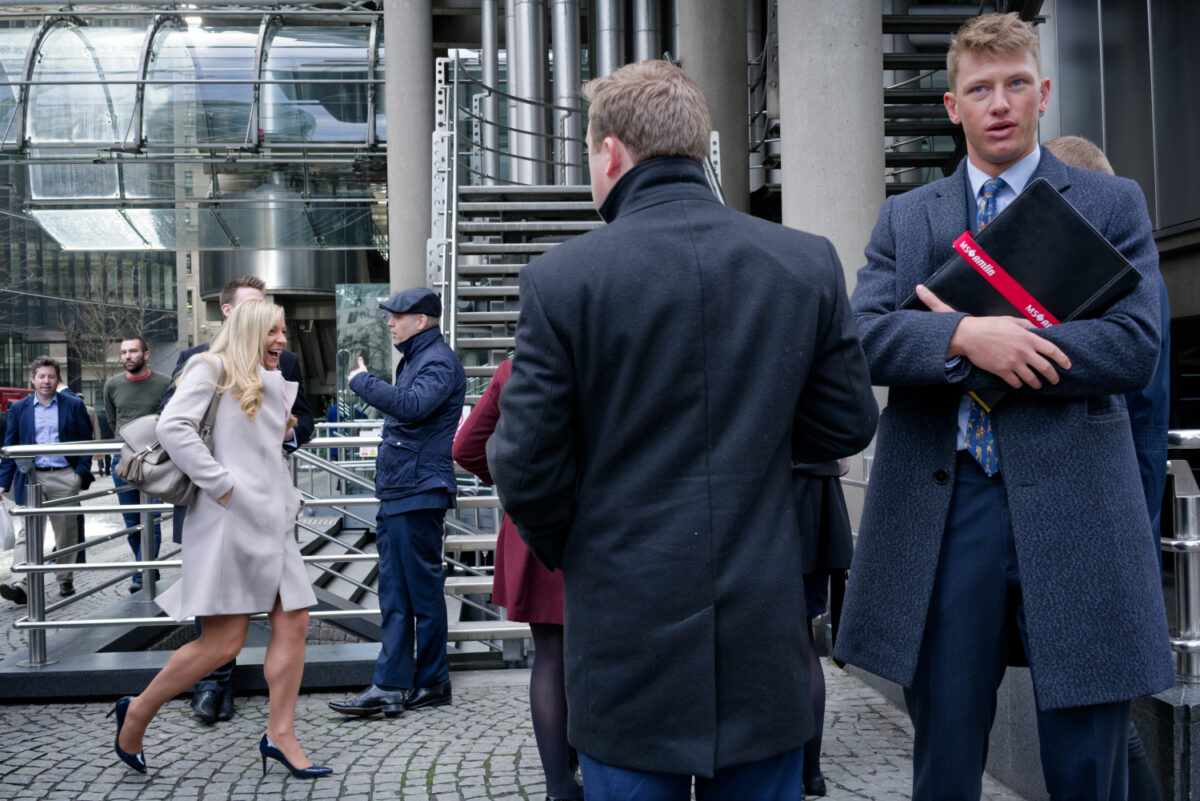
Here in this image, made on the pavement outside Lloyd’s, on a working weekday. A young man in a dark overcoat stands on the right of the frame, holding a branded folder, of an underwriting firm. He is looking off to his right, towards something out of frame. Behind him, three colleagues are talking in a close group. To the left, a woman in a cream coat, blonde, is half-turned in mid-stride, laughing at a friend, her hair catching the dull light off the steel and glass of the building’s exterior. The young man with the folder was my anchor. The woman laughing was the event that made the image. The picture is the combination, the City reading itself off two unrelated bodies on a public pavement, one branded by an underwriter, one breaking into a laugh in front of a building that handles a sizeable share of the world’s specialty insurance. No commissioned session inside a Lloyd’s syndicate would have produced this. No portrait sitting would have produced this. The street, with patience and worked for long enough, produced it.
Reading the street.
While making images on the street, I do not get names, I do not get biographies, I do not get the long interview, the back story, the morning ritual of one specific analyst. I work in patterns of performance and behaviour, and I read the social landscape through what is visible on the street: clothing, posture, group composition, the bag, the lanyard, the brand on a folder. Status in the City is performed through dress, and finance has its own dress code. The suit, the coat, the shoe, the watch, the hair, the way three colleagues stand together on a coffee break, the way a young man holds a corporate branded black folder while a woman in a cream coat laughs as she greets her friend behind him. I am relying on these things to do work that, in an embedded office documentary, would be done by caption, interview, and access.
The young man with the folder could be a junior actuary on a graduate scheme or a senior broker, his parents could have driven a delivery van in Stoke or sat on the board of a private bank, he could be the first in his family to work in the Square Mile or the third generation. The street picture cannot tell you which. The street picture shows you a young, well-dressed white man, on the pavement outside Lloyd’s, holding a folder from one of Lloyd’s underwriting firms. The reader sees the body and the brand. The work of the project is to put enough of these images together, made over five years across the same handful of streets, that the reader starts to see the pattern the body is part of. Weight of meaning is built through accumulation of elements in images through the project, not single images.
What does this method owe to other photographers?
Street photography is a working conversation with other photographers. Alex Webb’s layered street images, with their multiple-element frames and rhyming gestures across foreground and background, taught me how to build a picture in which more than one thing is happening at once. Other photographers work this way. Webb is the clearest teacher of it. Tony Ray-Jones taught me that English class on a public day out can be read off bodies, clothing, and the small gestures between strangers, and that the working camera position is the one the photographer can hold without breaking the scene. Robert Frank, in The Americans, taught me that pacing across a project does more political work than any single image is asked to do. Walker Evans taught me that clothing, signage, posture, and architecture can carry social-class information at the surface of a picture, without theatre and without intervention. Garry Winogrand showed me that you could photograph the chaos of the time, while on the streets of the city. These are my reference points, working this way becomes a conversation with what these photographers achieved while still trying to find my own way to make my images.
Paul Graham works in colour, and treats the book as the documentary object. His colour is social, it carries class, race, and place. In the City, that means the navy and charcoal of the suits, the pale blue and white of the shirts, the occasional red of a tie, the steel and glass of the office exteriors, the granite of the pavements, and the cloud-grey light of London for most of the working year. The sequencing, the editing, and the physical form of the book all carry the argument, and Graham has been willing to break the conventional book form when the project demands it.
The City, when you stand in it?
The City is the operational centre of the financial services industry in the United Kingdom, and one of two or three such centres globally. David Harvey has written for years on how financialisation works on the city: on its surface, its rents, its hours, and its faces. Zygmunt Bauman, on liquid modernity, gives the language for what it feels like to be one of the workers crossing the Bank junction at 12.45 on a Wednesday: identity attached to a firm that will restructure, a contract that can be ended on a Friday, a career that has to be portable because the industry is. The financial services industry leaves traces on the social landscape of the City because the industry is the social landscape of the City. Strip the workers out and the streets become a strange piece of corporate sculpture between St Paul’s and Liverpool Street. Put the workers back in and the City is a working place, with class signals, hierarchy, demographic shape, and a daily rhythm built around the markets and the post-work drink.
Why this work, and why now?
The financial services industry has reshaped London. It has reshaped the housing market, the political class, the public finances, the demography of the centre of the city, the kind of work the country tells its young people they should aim for. A documentary photographer working alone with a small camera on the pavements cannot answer all of that.
What I can do is render visible what is often overlooked: the actual people, the actual streets, the actual performances of class and status that make up the working day of the industry. There are people making exhibition decisions who want documentary work on capitalism, that does not import the language of capitalism back into the picture frame. There are readers of social documentary who suspect that long-form access projects have become a way of laundering corporate self-presentation back to the public. There is a future reader, fifty years out, looking at this 5-year window before the pandemic changed how the City was staffed, what people wore, and how they moved through those streets. The work is for all of them. The reader looks at the pictures, and the reader does the rest.
When worked as a long-term project on a defined subject, street photography becomes a social documentary method. The street is a different room from the office, with its own access, its own etiquette, and its own kind of attention. I walked the streets of the City for 5 years. I am editing the work now, to make sense of it and to find a publisher. There is more to do.